

Location
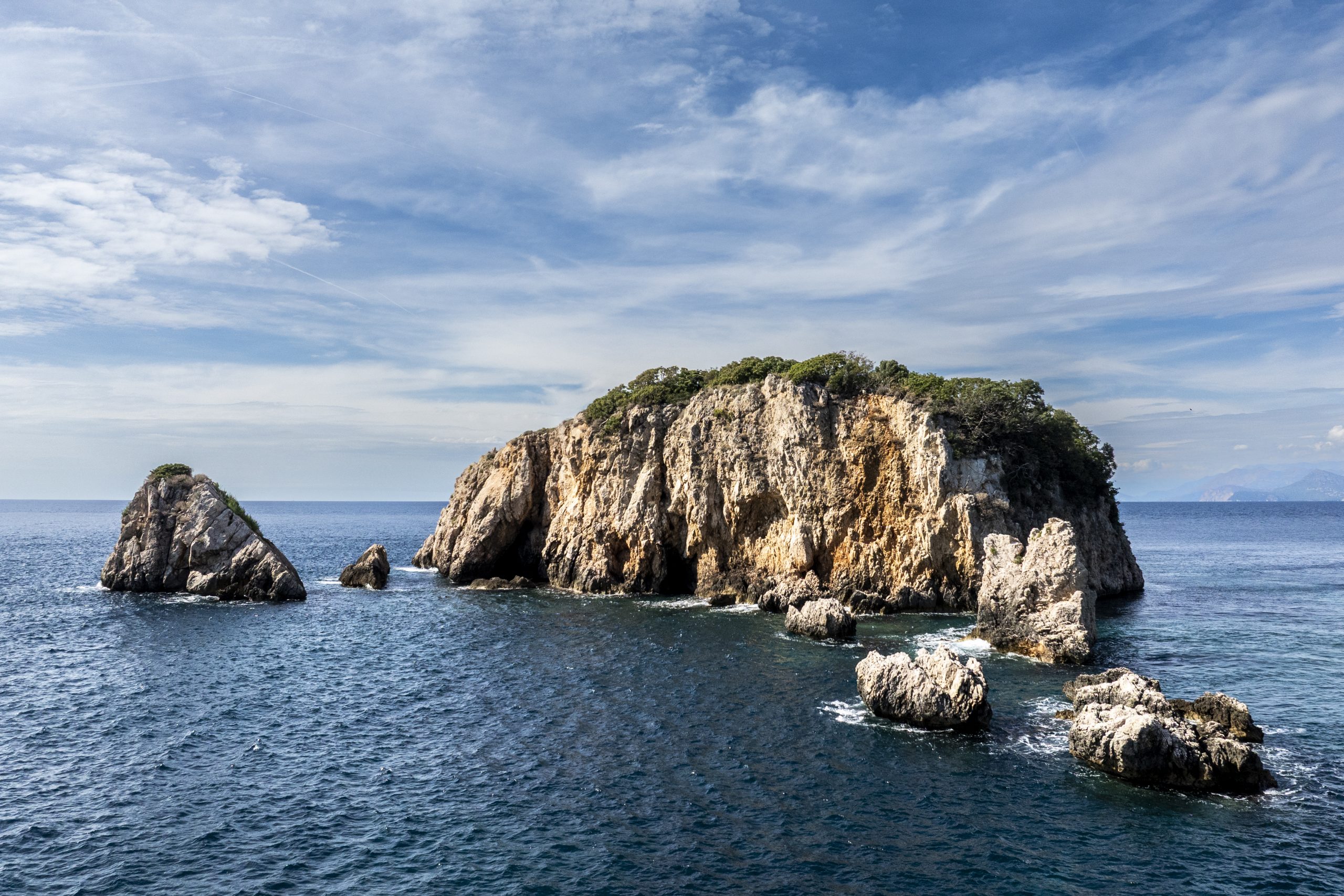
Nature Park Stari Ulcinj encompasses the coastal and marine area extending from the southern side of Cape Karastan to the northern end of Valdanos Cove. The Park is named after the visually dominant offshore islet of Stari Ulcinj, one of the area’s most recognizable landmarks.
The Nature Park covers a total area of 929 ha, comprising 912 ha of marine area and 17 ha of coastal land.
History
Nature Park Stari Ulcinj was designated a protected marine area by the Government of Montenegro in 2022.
As an integrated coastal and marine protected area, it is classified as an IUCN Category IV Protected Area (Habitat/Species Management Area), established to conserve wild plant and animal species and their habitats through active management.
Nature
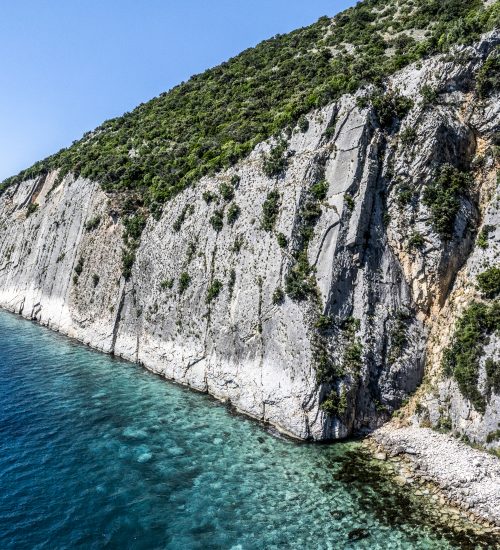
Nature Park Stari Ulcinj is a unique landscape where land and sea form an inseparable natural whole. The coastline is steep and rocky, continuously shaped by waves and wind, creating impressive geomorphological features including cliffs, capes (Rep, Marjan, Kep and Karastan) and picturesque coves such as Vučja Jama, Udovica, Lalova Njiva, Doce, Kruče and Hladna.
Recent scientific surveys have identified numerous habitats and species of exceptional ecological importance. Among the most valuable are the extensive meadows of Posidonia oceanica, an endemic Mediterranean seagrass that plays a crucial ecological role by producing oxygen, providing habitat and nursery grounds for marine organisms, stabilising sediments and protecting the seabed.
In addition to Posidonia meadows, the Park’s priority habitats include coralligenous assemblages, infralittoral communities and semi-submerged sea caves.
The marine area between Cape Rep and Valdanos Cove contains exceptionally well-developed coralligenous communities, among the richest benthic habitats in the Mediterranean. Their complex three-dimensional structure provides shelter, feeding grounds and spawning sites for numerous species of fish, crustaceans, molluscs and other marine invertebrates.
The Park’s remarkable marine biodiversity is further enhanced by the largest known Montenegrin population of the protected sponge Axinella cannabina, one of the country’s largest colonies of the stony coral (Cladocora caespitosa), as well as the presence of Cymodocea nodosa seagrass, the green alga Dasycladus vermicularis, and the brown alga Cystoseira compressa.
The coastal zone is characterised by highly valuable terrestrial habitats, including Mediterranean rocky shores with endemic Limonium species and evergreen Holm oak (Quercus ilex) forests.
Sights and Tourism
The Park’s outstanding natural values are complemented by a rich cultural heritage. Archaeological remains can be found on the islet of Stari Ulcinj, while the archaeological site of Kruče preserves the remains of a Roman rural villa (villa rustica). Nearby Valdanos, renowned for its centuries-old olive groves, represents one of the most distinctive cultural landscapes on Montenegro’s coast. Traditional olive cultivation has shaped the identity of this area for generations.
The underwater world of the Park also preserves valuable archaeological heritage, including the remains of merchant ships from different historical periods and late medieval galleons.
Nature Park Stari Ulcinj offers a unique combination of outstanding natural and cultural heritage, both above and below the sea surface.
Its rich marine biodiversity, underwater archaeological sites, coastal archaeological monuments, Holm oak forests and the centuries-old olive groves of nearby Valdanos create excellent opportunities for sustainable tourism, including diving, snorkelling, kayaking, sailing, hiking and traditional olive cultivation experiences.
Accessibility
The easiest way to reach Nature Park Stari Ulcinj is by sea, with the nearest port located in Bar.
The Adriatic Highway forms the Park’s landward boundary, while access from the mainland is provided by local gravel roads leading to the coastline.
Contact
Address
Public enterprise for Coastal Zone Montenegro
Popa Jola Zeca bb
85310 Budva
Crna Gora
Telefon
+382 33 452 709
Web: www.morskodobro.me